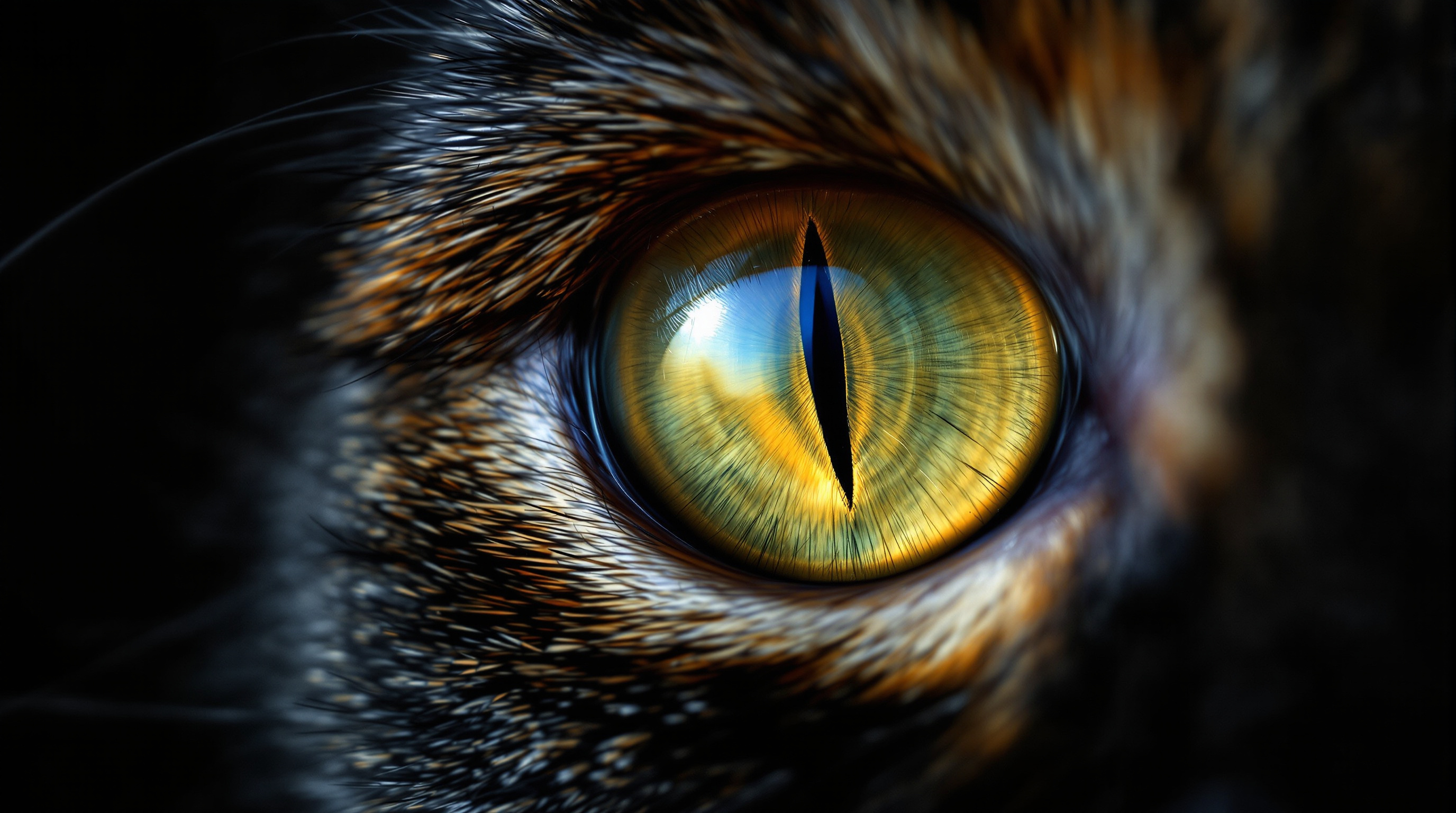
Of all the cat's senses, the eyes rank first in importance. A cat relies on its eyes to hunt and capture prey, and those eyes must function across an enormous range of conditions — from bright daylight to near-total darkness. Cats' eyes are very large in relation to their body size; the common domestic cat has eyes only slightly smaller than a human's.
Pupils That Change Shape
Large eyes with large pupils gather a great deal of light. In bright light, the pupil of a cat's eye closes down into a mere vertical slit, protecting the sensitive retina. In darkness, that same pupil dilates into a large round disk that takes up nearly the whole visible eye. The vertical-slit design lets a cat control incoming light far more precisely than a round pupil could — useful for an animal that hunts at dawn, at dusk, and by night.
Rods and Cones
In a mammal's eye there are two kinds of light-sensitive cells. Rods function in low levels of light; cones handle color vision and fine detail in bright light. Rods predominate in the cat's eye, which is exactly what you'd expect from a crepuscular hunter. Cats see less vivid color than we do, but they detect movement in dimness that would leave us blind.
The Mirror in the Eye
Behind the retina, cats have a reflective layer called the tapetum lucidum. It acts like a mirror, bouncing any light that missed a photoreceptor back through the retina for a second chance to be detected. This roughly doubles the use a cat gets from available light — and it's why a cat's eyes appear to glow when caught in headlights or a flashlight beam. That eyeshine is not the eye producing light; it's the tapetum returning it.
More Than Eyes
Vision leads, but it doesn't work alone. A cat's swiveling ears pinpoint the faintest rustle, and its whiskers read air currents and measure gaps in the dark. Together these senses make the cat one of the most complete low-light hunters on Earth. Learn how those senses scale up in Big Cats vs Little Cats, or return to Dija Know? for more.